
Truck and Commercial Vehicle Accident Lawyer in Michigan
A collision with a semi-truck, delivery van, work truck, or commercial vehicle is not simply a bigger car accident. These cases can involve companies, commercial insurance policies, safety regulations, and evidence that may not exist in a typical crash.
Run Point.

Mungo Law helps injured people understand what happened and who may be responsible. We serve Wayne County, Genesee County, Oakland County, and communities throughout Michigan. You run point. We help you understand the court, evaluate your options, and build a game plan for what comes next.
Why Are Truck and Commercial Vehicle Accidents Different?
Commercial vehicles spend long hours on Michigan roads while transporting goods, equipment, and people. Their size can increase the risk of serious injuries when something goes wrong. Yet vehicle size is only part of what makes these cases different.
A commercial vehicle claim may involve several businesses and insurance policies. Federal motor carrier regulations may also apply to certain vehicles and drivers. The investigation can extend well beyond the person behind the wheel.
A Commercial Crash May Involve More Than One Player
Depending on the facts, an investigation may examine:
- The commercial driver
- The driver's employer
- A trucking or motor carrier company
- The vehicle's owner
- A maintenance or repair contractor
- A cargo or loading company
- A vehicle or component manufacturer
- Another driver or third party
More than one party could share responsibility for a crash. Identifying each party can help determine which insurance policies and legal claims may apply.
Not Just A Bigger Vehicle
A passenger car crash often centers on the drivers involved. A commercial vehicle crash may require examining a driver's actions, company practices, vehicle records, maintenance, cargo, and applicable safety rules.
What Types of Commercial Vehicle Accidents Do We Handle?
Commercial traffic takes many forms across Michigan. A serious crash does not need to involve an 18-wheeler to raise commercial liability issues.
Mungo Law can evaluate accidents involving:
- Semi-trucks and tractor-trailers
- 18-Wheelers
- Box trucks
- Delivery trucks and vans
- Dump trucks
- Construction vehicles
- Utility and service vehicles
- Tow trucks
- Garbage and refuse trucks
- Cargo and freight vehicles
- Commercial fleet vehicles
- Other work vehicles
Common Types of Commercial Vehicle Crashes
Some crashes involve driver error. Others may involve equipment, cargo, training, maintenance, or several contributing factors.
Common accident scenarios include:
- Rear-end collisions
- Jackknife accidents
- Underride crashes
- Blind-spot collisions
- Unsafe lane changes
- Wide-turn accidents
- Lost or unsecured cargo
- Brake or tire failures
- Driver-fatigue crashes
The vehicle type and crash pattern can provide important clues. A careful investigation looks beyond the obvious explanation.
- Semi-trucks and tractor-trailers
- Box trucks
- Delivery trucks and vans
- Dump trucks
- Construction vehicles
- Utility and service vehicles
- Commercial fleet vehicles
- Jackknife accidents
- Underride crashes
- Blind-spot collisions
- Unsafe lane changes
- Wide-turn accidents
- Lost or unsecured cargo
- Brake or tire failures
What Causes Truck and Commercial Vehicle Crashes?
Commercial drivers have demanding jobs, but they still must operate their vehicles safely. Companies also have responsibilities that can affect what happens on the road.
A crash investigation may examine decisions made before the vehicle ever entered traffic.
Driver-Related Factors
Potential driver-related causes can include:
- Distracted driving
- Following too closely
- Unsafe lane changes
- Fatigue
- Impaired driving
- Failure to adjust for weather or traffic conditions
Company and Vehicle-Related Factors
The driver's actions may be only one part of the story. Other contributing factors can include:
- Inadequate driver training
- Negligent hiring or supervision
- Unsafe scheduling practices
- Poor vehicle maintenance
- Inadequate inspections
- Brake or tire problems
- Improper cargo securement
- Vehicle overloading
- Defective vehicle components
Many people do not realize how far a commercial crash investigation can extend. Company decisions made days or weeks earlier could become relevant after an accident.
Who May Be Responsible for a Michigan Truck Accident?
The commercial driver may be responsible if negligent driving caused the collision. However, liability does not necessarily stop with the driver.
An employer or motor carrier could also face liability in some circumstances. Vehicle owners, maintenance contractors, loading companies, manufacturers, or other parties could also become relevant.
Why Multiple Parties Matter
Determining responsibility can affect how a claim is investigated and which insurance coverage may be available. It can also help explain why the crash occurred.
For example, a brake failure raises different questions than distracted driving. Investigators may need maintenance records, inspection documents, company policies, or information about defective components.
| The commercial driver | May be responsible if negligent driving caused the collision. |
| The employer or motor carrier | Could also face liability in some circumstances, depending on the facts. |
| The vehicle's owner | The company name on a truck may not identify who owned the vehicle. |
| A maintenance or repair contractor | Relevant where maintenance, inspections, or a brake or tire problem is in question. |
| A cargo or loading company | Relevant where cargo securement or vehicle overloading may have contributed. |
| A vehicle or component manufacturer | Relevant where a defective vehicle component may be involved. |
What Evidence Matters After a Commercial Vehicle Crash?
Evidence can tell the story that memories alone cannot. Commercial vehicles and their operators may also generate records that are unavailable in an ordinary passenger vehicle accident.
Depending on the vehicle and circumstances, relevant evidence may include:
- Electronic logging device records
- Vehicle or event data
- Driver qualification records
- Driver training records
- Hours-of-service information
- Inspection reports
- Maintenance and repair records
- Cargo and loading documents
- Dispatch records
- Company communications
- Dashcam footage
- Nearby surveillance video
- Police reports
- Witness statements
- Crash-scene photographs
- Medical records
Some records or electronic information may not remain available indefinitely. An early investigation can help identify what evidence exists and what steps may be appropriate to preserve it.
A commercial crash comes down to what the driver did in the seconds before impact.
Company decisions made days or weeks earlier could become relevant after an accident, including training, hiring, supervision, scheduling, maintenance, inspections, and cargo securement.
Follow the Evidence, Not Assumptions
A truck's company name does not automatically tell you who employed the driver. It also may not identify who owned, loaded, or maintained the vehicle.
That is why these cases require questions before conclusions. We work to understand how the pieces fit together before developing a legal strategy.
What Should You Do After a Truck Accident?
The hours after a serious crash can feel chaotic. Your health and immediate safety should come first.
The hours after a serious collision can be confusing. Your health and immediate safety come first. If you are able, these steps may also help preserve information that could become important later.
- 1Get to safety and report the crash. Move away from traffic or other immediate danger when it is safe to do so.
- 2Seek medical attention. Get care for your injuries even if you are unsure how serious they may be.
- 3Ask for the police report. Law enforcement documentation is often an important starting point for understanding the circumstances of the collision.
- 4Photograph the scene. Vehicle damage, road conditions, debris, traffic controls, and skid marks may provide useful context later.
- 5Capture the truck’s identifying details. If possible, photograph company names, logos, DOT numbers, license plates and trailer markings.
- 6Collect witness information. Ask witnesses for their names and contact details if circumstances allow.
- 7Keep every record. Save medical bills, treatment documents, repair estimates, receipts and correspondence.
- 8Track your financial losses. Missed work, reduced hours, transportation expenses and other effects connected to the crash.
- 9Be careful with recorded statements. An insurer may ask for a recorded account. Understand who is asking and why before you provide information.
- 10Do not try to map the whole company yourself. You do not need to identify every responsible company, policy or trucking record on your own. A lawyer can help evaluate what should be asked next.
Preserve what you reasonably can, take care of your health, and ask for help when you need it. Commercial vehicle investigations involve records that injured people should not be expected to track down alone.
What Compensation May Be Available?
Michigan auto accident claims can involve different sources of benefits and compensation. What may be available depends on the facts, injuries, insurance coverage, and applicable law.
An injured person may have a claim involving losses such as:
- Medical expenses
- Lost wages
- Reduced earning capacity
- Rehabilitation expenses
- Long-term care needs
- Pain and suffering
- Disability or loss of function
- Property damage
- Other accident-related losses
Michigan No-Fault Benefits and At-Fault Claims
Michigan's no-fault system can affect how certain accident-related benefits are handled. A separate claim against an at-fault party may also be possible in qualifying circumstances.
These are different parts of the legal picture. We help clients understand how those pieces may work together based on their situation.
If a commercial vehicle crash causes a death, surviving family members may also have rights under Michigan's wrongful death laws. Those claims involve separate legal and procedural considerations.
Every case is different. Speak to a lawyer to understand your rights.
Serving Wayne, Genesee and Oakland Counties, and Michigan Statewide
Commercial vehicles move through Michigan every day. Interstate highways, local roads, construction zones, industrial areas, and neighborhood delivery routes can all become accident scenes.
Mungo Law represents injured people across Michigan, with a particular focus on Wayne County, Genesee County, and Oakland County.
Wayne County Truck and Commercial Vehicle Accidents
Detroit and surrounding Wayne County communities experience significant commercial and delivery traffic. Major highways also bring passenger vehicles into close contact with trucks and freight traffic.
We can evaluate commercial vehicle crashes throughout Wayne County. That includes accidents involving trucks, delivery fleets, work vehicles, and other commercial operators.
Genesee County Truck and Commercial Vehicle Accidents
Flint and communities throughout Genesee County sit near important Michigan transportation routes. I-69 and I-75 carry commercial vehicles alongside everyday passenger traffic.
We help clients understand the legal issues that may follow serious commercial vehicle crashes in Genesee County. The first step is understanding the facts and identifying the right questions.
Oakland County Truck and Commercial Vehicle Accidents
Mungo Law is based in Novi and serves communities throughout Oakland County. Roads including I-96 and I-696 carry substantial commuter and commercial traffic.
Commercial accidents can also happen away from highways. Delivery vans, construction vehicles, service trucks, and fleet vehicles operate throughout Oakland County communities every day.
You Run Point. We Help Build the Game Plan.
After a commercial vehicle crash, you may face medical appointments, missed work, insurance questions, and uncertainty. Meanwhile, a trucking company or commercial insurer may already be investigating the collision. You deserve your own understanding of what happened and what Michigan law may allow you to do.
At Mungo Law, you run point. We listen, explain your options, investigate the facts, and develop a strategy around your needs. Whether you are in Wayne, Genesee, Oakland County, or elsewhere in Michigan, our goal is simple: help you make informed decisions about what comes next.
Ready to Talk About What Happened? Put Mungo Law on Your Team.
You do not need to identify every responsible party before contacting us. You also do not need to understand trucking regulations, commercial insurance, or vehicle data. Those are questions we can help you explore.
Request a free consultation with Mungo Law. Tell us what happened and get answers about your potential options under Michigan law. All calls and correspondence are responded to within 24 hours.
What people ask us about this claim.
What Company Decisions Can Become Relevant After a Truck Crash?
The driver's actions may be only one part of the story. A crash investigation may examine decisions made before the vehicle ever entered traffic, including inadequate driver training, negligent hiring or supervision, unsafe scheduling practices, poor vehicle maintenance, inadequate inspections, brake or tire problems, improper cargo securement, vehicle overloading, and defective vehicle components.
Many people do not realize how far a commercial crash investigation can extend. Company decisions made days or weeks earlier could become relevant after an accident, which is one reason a brake failure raises different questions than distracted driving.
What Compensation May Be Available After a Truck Accident?
What may be available depends on the facts, injuries, insurance coverage, and applicable law. An injured person may have a claim involving medical expenses, lost wages, reduced earning capacity, rehabilitation expenses, long-term care needs, pain and suffering, disability or loss of function, property damage, and other accident-related losses.
Michigan's no-fault system can affect how certain benefits are handled, and a separate claim against an at-fault party may also be possible in qualifying circumstances. Every case is different. Speak to a lawyer to understand your rights.
Does the Company Name on the Truck Identify Who Is Responsible?
Not necessarily. A truck's company name does not automatically tell you who employed the driver. It also may not identify who owned, loaded, or maintained the vehicle.
That is why these cases call for questions before conclusions.
Is a Truck Accident Claim Different From a Car Accident Claim?
Usually, yes. A passenger car crash often centers on the drivers involved. A commercial vehicle crash may require examining a driver's actions, company practices, vehicle records, maintenance, cargo, and applicable safety rules.
Federal motor carrier regulations may also apply to certain vehicles and drivers, so the investigation can extend well beyond the person behind the wheel.
What Should I Do After a Truck or Commercial Vehicle Crash?
Your health and immediate safety come first. If you are able, move away from traffic or other immediate danger, get care for your injuries even if you are unsure how serious they may be, and ask for the police report, which is often an important starting point for understanding the circumstances of the collision.
When circumstances allow, photograph vehicle damage, road conditions, debris, traffic controls, and skid marks, and capture company names, logos, DOT numbers, license plates, and trailer markings. Ask witnesses for their names and contact details, and save medical bills, treatment documents, repair estimates, receipts, and correspondence. Some records or electronic information may not remain available indefinitely.
Do I Need to Know Who Caused the Crash Before Contacting a Lawyer?
No. You do not need to identify every responsible party before contacting us, and you do not need to understand trucking regulations, commercial insurance, or vehicle data.
Those are questions we can help you explore. All calls and correspondence are responded to within 24 hours.
Free consultation
Still not sure where you stand? One call is enough to find out, and it costs nothing.
Written on this subject
All posts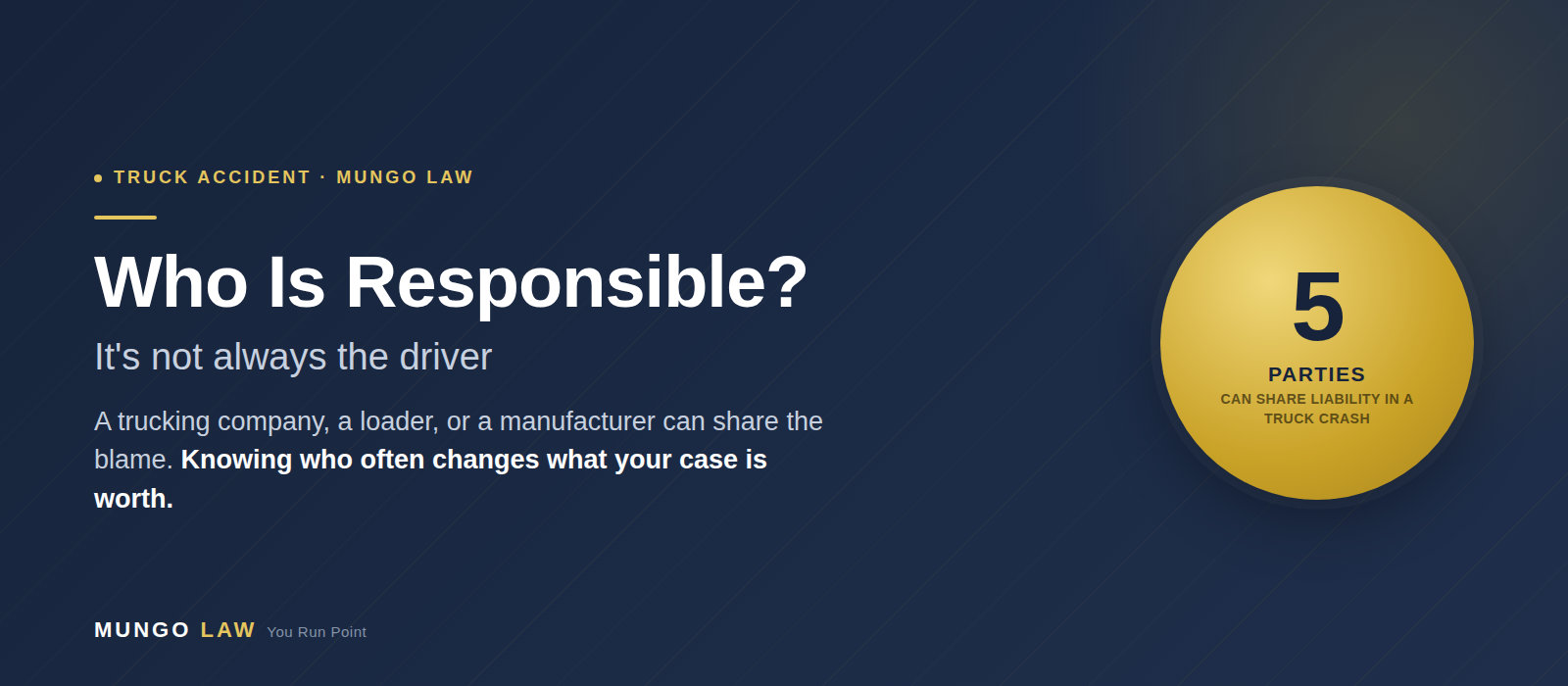
Free consultation
Reading helps. An answer on your own facts helps more, and it costs nothing to get one.
Guides on this subject
All guidesNothing here yet
No guide covers this one yet.
Guides are the longer pieces, written for decisions rather than questions. None of them deals with this area yet. The full set is one click away, and the FAQs above cover most of what gets asked here.
Read the guidesFree consultation
Not sure which of these fits your situation? One call sorts it faster than any website can.
You do not have to figure this out alone.
One conversation is enough to know where you stand. It costs nothing, and you will speak with Brandyn.